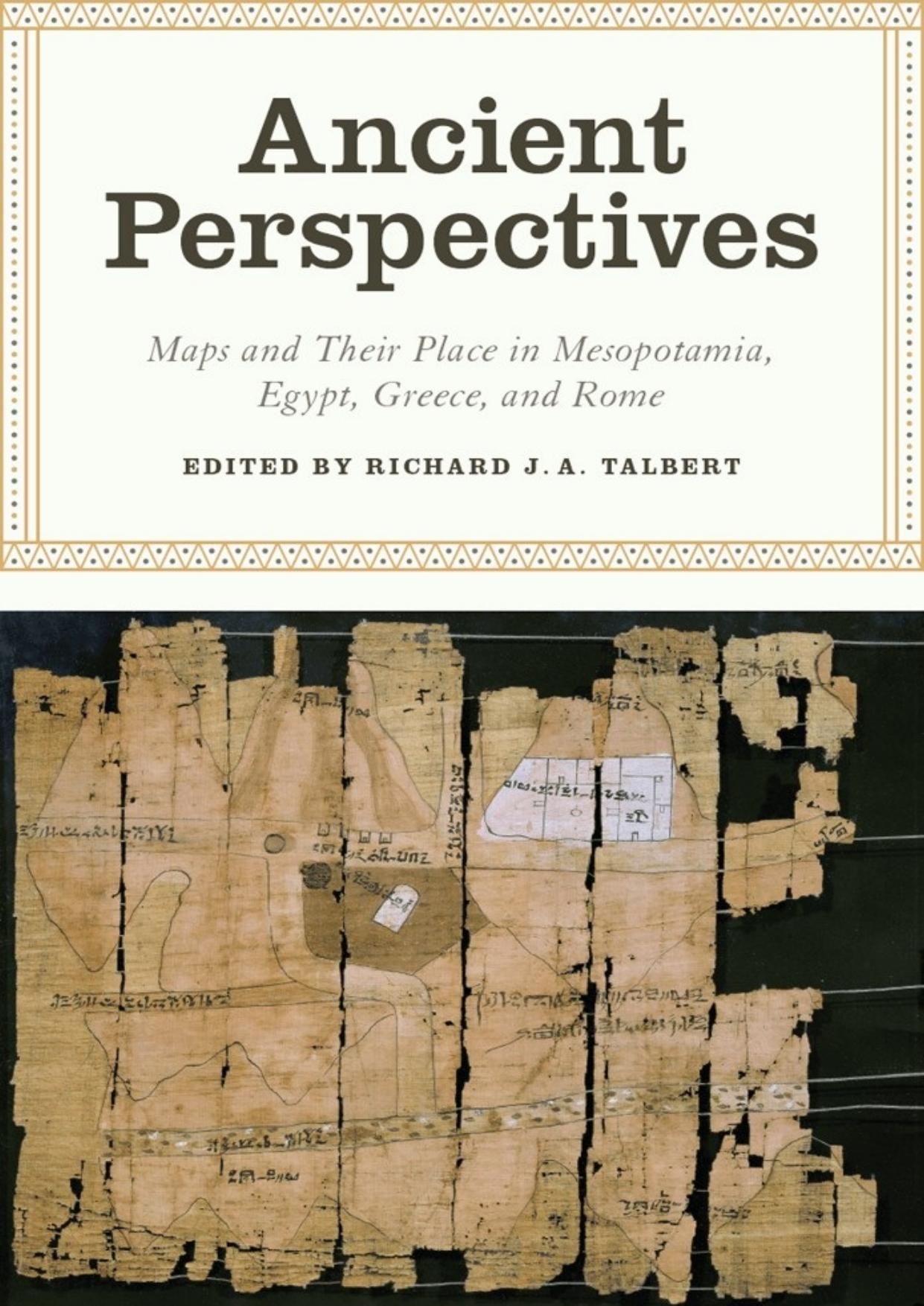
Ancient Perspectives: Maps and Their Place in Mesopotamia, Egypt, Greece and Rome by Richard J. A. Talbert
Author:Richard J. A. Talbert [Talbert, Richard J. A.]
Language: eng
Format: epub, pdf
Published: 2017-01-18T05:00:00+00:00
The engineers were essentially correct. Tidal effects, exacerbated by winds, mean that the sea level west of the isthmus is always higher than that on the east, with a maximum difference—we now know—of 51 cm. There is consequently a permanent current of up to 4.8 km per hour through the modern canal, which was completed in 1893. This causes little practical difficulty, and Aegina is still there. The canal being 6.342 km long, its surface has a maximum gradient of 1 in 12,435 (0.008%), thus comparable with the gentlest gradients on Roman aqueducts, which must have taxed the skills and instruments of their surveyors to the limit. Demetrius’s surveyors can only have leveled from sea level up to at least 79 m on the ridge and down again, at a date when dioptras, at least in their developed form, did not exist. It is all too easy to hail their result as a triumph. But it is not recorded what they supposed the difference in sea level to be. If it were known that they found it to be a cubit (roughly 50 cm), a triumph it could very well have been. But would so small a difference have raised fears for the safety of Aegina, 35 km away? Had the surveyors found it to be, say, 6 cubits (roughly 3 m), that would have been a massive error, which could just as easily have been in the opposite direction and made the eastern sea higher than the western. Such a finding would have been written off by posterity as a failure. We have to conclude, regretfully and at the risk of doing Demetrius’s engineers a grave injustice, that their survey was probably not very accurate, and that it was only chance which made them err in the right direction.
Short distances were measured by chains, the most reliable method; or by cords, which were cheaper but liable to stretch or shrink; or by wooden rods of standard length (with metal ferrules to protect their ends) tediously leapfrogging each other. Even so, throughout antiquity and long thereafter, measuring long distances—several miles, or hundreds—was inordinately difficult. Alexander the Great on his conquests far into Asia employed “bematists,” pacers, who counted their paces as they marched and noted the direction of travel and the names of places passed.²¹ From their records, outline maps were compiled and descriptions of the routes published. The result was a vast improvement on anything that had gone before, but there remain severe limitations to the accuracy of pacing. It is notoriously difficult to maintain a straight path and an even pace through forest or swamp.
Geographers could reckon the distance between places on the same meridian by observing stars with the dioptra, just as was done later with the great medieval instrument that was its direct descendant, the astrolabe. The method was comparable to that of Eratosthenes, but in reverse. Geographers found a star which at a given time is vertically overhead at A, and at B, at the
Download
Ancient Perspectives: Maps and Their Place in Mesopotamia, Egypt, Greece and Rome by Richard J. A. Talbert.pdf
This site does not store any files on its server. We only index and link to content provided by other sites. Please contact the content providers to delete copyright contents if any and email us, we'll remove relevant links or contents immediately.
Whiskies Galore by Ian Buxton(42160)
Introduction to Aircraft Design (Cambridge Aerospace Series) by John P. Fielding(33248)
Small Unmanned Fixed-wing Aircraft Design by Andrew J. Keane Andras Sobester James P. Scanlan & András Sóbester & James P. Scanlan(32875)
Aircraft Design of WWII: A Sketchbook by Lockheed Aircraft Corporation(32382)
Craft Beer for the Homebrewer by Michael Agnew(18343)
Turbulence by E. J. Noyes(8214)
The Complete Stick Figure Physics Tutorials by Allen Sarah(7485)
The Institute by Stephen King(7153)
The Thirst by Nesbo Jo(7105)
Kaplan MCAT General Chemistry Review by Kaplan(7055)
Bad Blood by John Carreyrou(6731)
Modelling of Convective Heat and Mass Transfer in Rotating Flows by Igor V. Shevchuk(6590)
Weapons of Math Destruction by Cathy O'Neil(6469)
Learning SQL by Alan Beaulieu(6404)
Man-made Catastrophes and Risk Information Concealment by Dmitry Chernov & Didier Sornette(6220)
Permanent Record by Edward Snowden(5963)
Digital Minimalism by Cal Newport;(5934)
Life 3.0: Being Human in the Age of Artificial Intelligence by Tegmark Max(5689)
iGen by Jean M. Twenge(5511)
